
SABS R³
Welcome to the SABS R3 CDT, also known as the Sustainable Approaches to Biomedical Science: Responsible and Reproducible Research Centre for Doctoral Training. It has been funded major awards from the UKRI funding councils EPSRC and MRC, supported by our SABS partners.
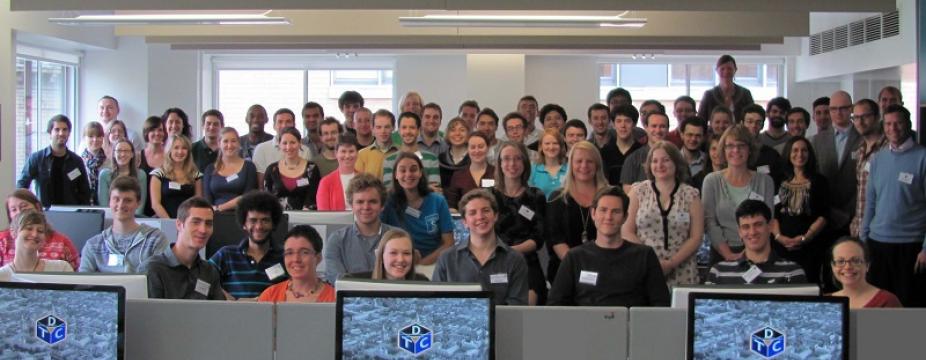
Since 2009, we have trained doctoral student cohorts in cutting-edge, collaborative systems approaches to biomedical research - and, uniquely within the UK, since 2019, in advanced practices in software engineering. Our goal has been to bring about a transformation of research culture in computational biomedical science.
Nowadays, computational methods are at the heart of biomedical research. From prediction to simulation of the behaviour of complex systems, through the design and automation of laboratory experiments, to the analysis of both small and large-scale data sets, well-engineered software has proved essential to transforming biomedical science.
SABS R3 builds on the internationally leading track record of innovative, interdisciplinary scientific training already established by our EPSRC & MRC Systems Approaches to Biomedical Science (SABS) CDT programme. The original EPSRC SABS Industrial Doctoral Centre (IDC) was established in 2009 as an open innovation partnership between researchers at the University of Oxford and 13 organizations from across the pharmaceutical and biomedical technologies sectors, and now has 30 partners, including some of the largest pharmaceutical companies in the world.
SABS has inspired the new Open-IIC industrial doctoral sub-programme of the BBSRC and NERC Interdisciplinary Life and Environmental Science Landscape Award (ILESLA) programme: and the new BBSRC Industrial Doctoral Landscape Award (IDLA) in Transformative Technologies in Pharmaceutical Science (TTPS) supported by GSK.
You can hear from our students, industrialists, and academics about the SABS programme in this video:
SABS R3 builds on the existing SABS Programme to equip a new generation of researchers with not only the knowledge and methods necessary to undertake quantitative and interdisciplinary biomedical research, but also advanced software engineering skills. By embedding this strong focus on sustainable and open computational methods, together with responsible and reproducible approaches into all aspects of the new programme, our computationally-literate students are working with our partners to become ambassadors helping to transform biomedical research.
SABS R3 is based in the Mathematical and Physical Sciences Doctoral Training Centre.